What do comparable sales say about your home?Your home vs recent sales
Enter your address to see the comparable sales around it. Free, no sign-up.Free comparable sales for your address.
🔍
Analyst17 September 2026·Updated 20 September 2026·4 min read
The auction market has halved in a year
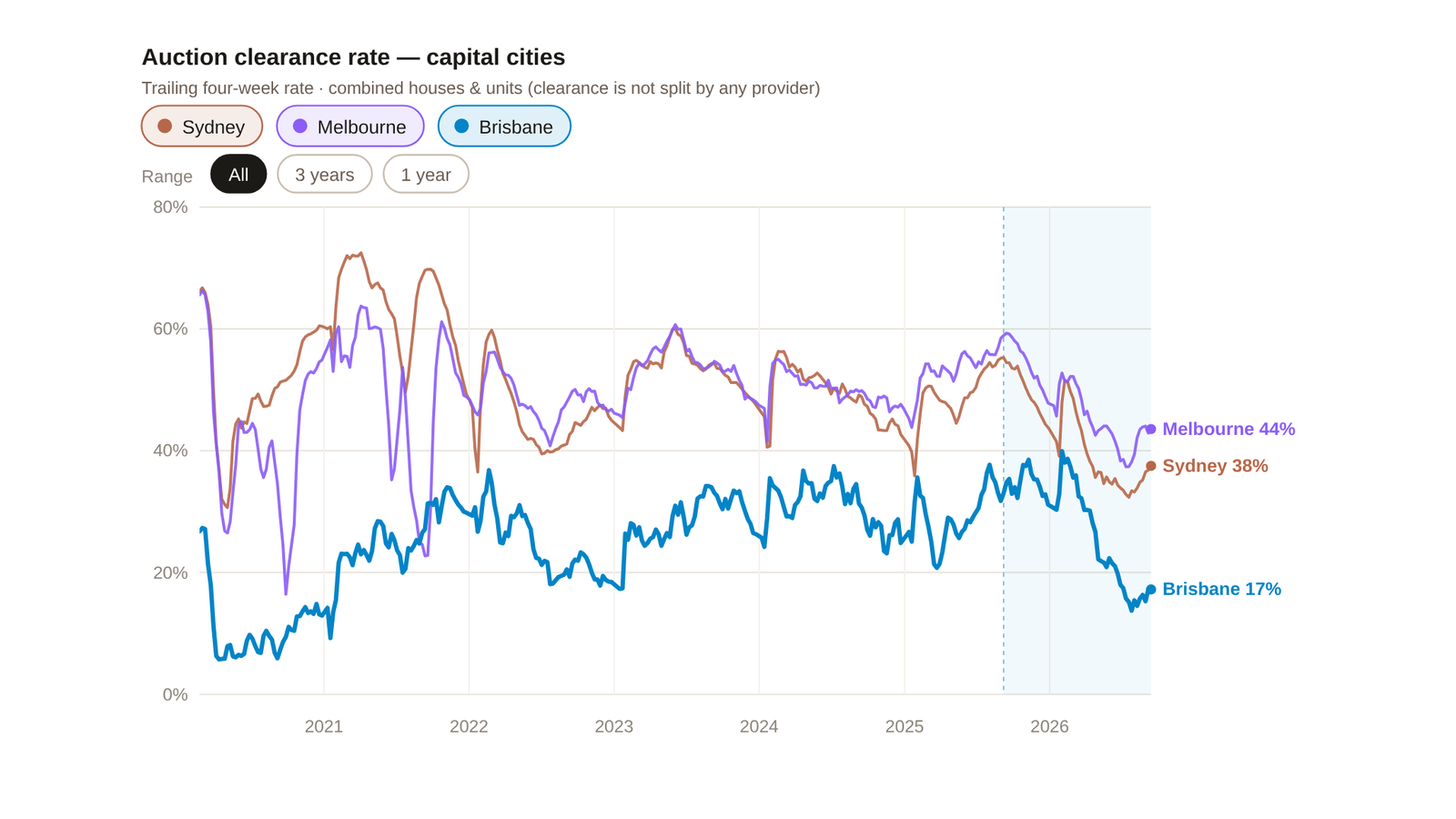
Across our region, the share of homes selling under the hammer has fallen from about one in three a year ago to roughly one in six today — what the numbers show, and two things about auctions most buyers and sellers never see.
A year ago, about a third of homes taken to auction in our region sold under the hammer. This
September, it is closer to one in six. The nearest capital auction market to the Gold Coast —
Brisbane — cleared 33% of its auctions in early September
2025. In the week to 13 September 2026 that figure was 17%. The
clearance rate has, in round terms, halved.
Auction clearance rate, trailing four-week rate. This is an inherently combined house-and-unit measure — auction clearance is reported combined by every provider (SQM, CoreLogic, Domain) and is not split by property type. Homes sold — before, at, or after auction — as a share of all auctions scheduled. Brisbane is shown as the nearest capital auction market; the Gold Coast is a private-treaty market and has no clearance series of its own. Hover or tap any point for each city’s rate and the number of auctions behind it. Source: SQM Research, to 2026-09-16.
The fall is not unique to Queensland — clearance has softened across the eastern capitals — but
Brisbane sits at the bottom of the three largest markets. The backdrop is familiar: interest rates
rose through the year, buyer demand cooled, Gold Coast prices eased off their highs, and the auction
clearance rate followed. When fewer buyers are competing on the day, fewer auctions end in a sale.
Two things about auctions most people never see
1
Most buyers skip a home with no price
Research by REA Group (realestate.com.au), 2014, found that 72% of
buyers pass over listings that don't display a price. In Queensland, that is most
auction campaigns: state law prohibits agents and auctioneers from publishing any price guide on
a residential auction — including the reserve — under the Property Occupations Act 2014
(Qld), sections 214 and 216. A home taken to auction is therefore seen by a smaller pool of
buyers than one carrying a number.
2
A failed auction tends to sell for a little less
A study of more than 480,000 sales across New South Wales and Victoria
(Cortés and colleagues, University of New South Wales, published in the Review of
Finance, July 2026) found that a successful auction beat private treaty by only about 0.7%.
But roughly one auction in five failed, and those homes then sold about
1.3% below comparable private-treaty sales. The study also found the penalty for a failed
auction is larger in hot markets, where a pass-in is a rarer, louder signal.
1.3%
the gap between a failed auction and a comparable
private-treaty sale in the NSW/VIC research. If the same gap held on a house at our current rolling
twelve-month medians — Robina $1,495,000, Varsity Lakes $1,400,000,
Burleigh Waters $1,925,000 — it would be roughly $18,000 to $25,000.
The figure is drawn from southern-state data; we note it as an indication, not a Gold Coast
measurement.
Why the listing method is itself a signal
In Queensland, auctions are more common for houses than for units. Units are straightforward to
compare — many near-identical sales sit alongside each other — so they tend to carry a firm asking
price. Houses are each different, and are more often listed without one. That means a no-price
listing is more likely to be a house, and more likely to be exactly where independent valuation
context is most useful.
Auction also concentrates a decision into a single day, with finance and due diligence arranged
in advance. That format is more established in the southern states than in Queensland, where a buyer
weighing an auction home against a priced private-treaty home has more time to do their checks on
the latter.
Put together, the way homes are being listed has become a real-time read on the market. When
clearance rates halve and more vendors carry a number, that mix is itself a measurable sign of a
softer, more buyer-friendly market — a read that is rarely published where buyers and sellers can
see it.
Queensland law prevents an agent from publishing a price guide at auction. It
does not prevent an independent party from publishing the market context around a home. That is why
every auction property on Fields carries a Valuation Guide: the comparable evidence and the method
behind it, in one place, so the number that is missing from the listing is not missing from your
decision.
Sources & notes. Auction clearance: SQM Research,
trailing four-week volume-weighted rate, combined house & unit types, capital cities (data begins
February 2020; the Gold Coast is a private-treaty market with no clearance series). Buyer behaviour:
REA Group (realestate.com.au), 2014. Auction vs private-treaty outcomes: Cortés et al., University of New
South Wales, Review of Finance, July 2026 (480,000+ NSW/VIC sales, 2007–2019) — a southern-state study
cited as indication, not a Gold Coast measurement. Medians: Fields rolling twelve-month medians to
13 September 2026. Auction price-guide law: Property Occupations Act 2014 (Qld), ss 214
& 216. This article reports data and does not constitute advice.
Licensed Queensland real estate agent, founder of Fields Real Estate and Lead Analyst at Fields Research. Covering Gold Coast market data, comparable sales analysis and suburb intelligence.
Where does your own home sit?
Fields keeps a record of every active listing and recent sale across the southern Gold Coast, and reads any address against the sales around it — the comparables, the range they support, and the method behind it. This analysis of the Gold Coast comes from the same database.