What do comparable sales say about your home?Your home vs recent sales
Enter your address to see the comparable sales around it. Free, no sign-up.Free comparable sales for your address.
🔍
Analyst21 August 2026·Updated 22 September 2026·6 min read
The fundamentals of the Gold Coast market
Sydney and Melbourne fell; the Gold Coast held. Not luck — a 5bn, health-led economy that stopped being a tourism town, an equity-funded buyer base, tight supply, and a decade of committed infrastructure.
Over the past year, Sydney dwelling values fell about 2%, Melbourne about 2.8%, and Brisbane — after a long run as the country’s strongest capital — turned down too. The Gold Coast did not. On PropTrack’s Gold Coast measure, values are up about 7.8% over the year and have flattened rather than fallen in recent months.
That gap in performance is the interesting question. A city that was, in the popular imagination, a holiday strip built on tourism and construction ought to be more exposed to a downturn, not less. The reason it has held up is that the popular imagination is a generation out of date. The Gold Coast’s economy has quietly changed underneath the postcard, and those changes are the fundamentals worth understanding.
It stopped being a tourism town
The Gold Coast is now a $55.2 billion economy that grew 3.7% in the year to June 2025, and it is home to about 691,000 people — the second-largest local government area in the country. More to the point, it is broad-based.
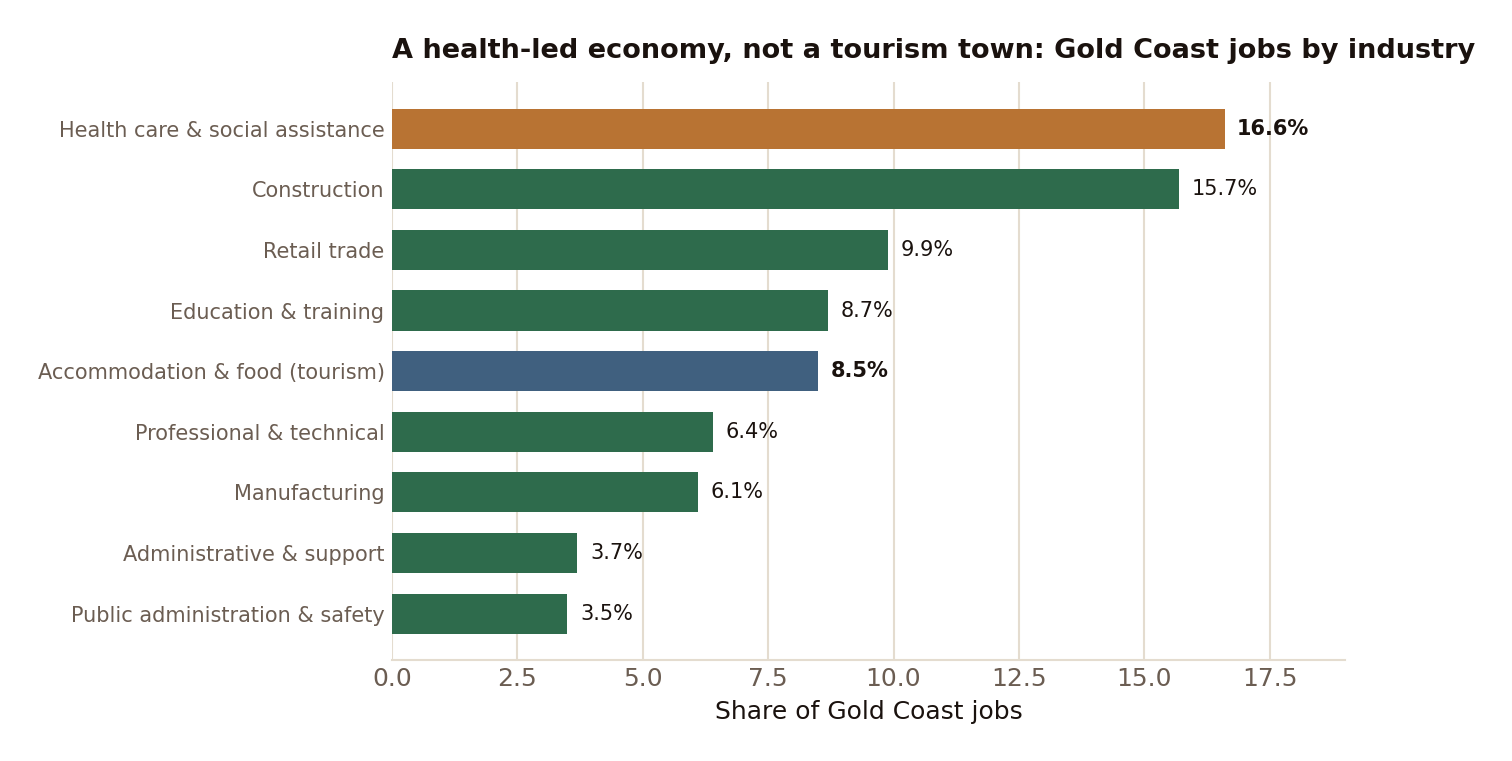
The single largest employer is not tourism. It is health care and social assistance, at 16.6% of all jobs — nearly double the tourism workforce. Accommodation and food services, the closest proxy for tourism, accounts for just 8.5% of jobs. Construction is large (15.7%), and beyond those, no single industry dominates: retail, education, professional services and manufacturing each sit in the mid-to-high single digits.
Gold Coast jobs by industry. Health care leads and tourism sits mid-pack — a broad base rather than a single-sector economy. (City of Gold Coast economic profile / NIEIR, 2024/25.)
Why this matters for property: a diversified economy spreads its risk. When one sector slows, others carry it, so household incomes across the city do not rise and fall together. Health care in particular is largely counter-cyclical — demand for it does not retreat when interest rates rise. An economy built on one industry moves with that industry; this one does not.
The honest caveat is construction. At 15.7% of jobs it is the second-largest employer and the one big rate-sensitive, cyclical sector, heavily tied to the housing and infrastructure build. The Gold Coast is diversified, not immune: a sustained construction slowdown would still be felt. But “diversified with one cyclical exposure” is a very different risk profile from “a tourism town.”
Who is buying, and why it holds
The second fundamental is on the demand side. The rate rises of 2026 cut hardest into buyers who borrow to their limit — and they are concentrated in the expensive mortgage-belt suburbs of Sydney and Melbourne. The Gold Coast’s buyer base leans differently: a larger share of interstate movers arriving with capital from a dearer city, downsizers, and lifestyle buyers who are less dependent on the size of a new loan. Where mortgage-dependent demand has retreated, equity-funded demand has kept transacting. (This is the balance of market commentary rather than something we can measure sale by sale, but it is consistent with what the figures show.)
Behind that sits migration. Queensland remains the country’s top state for interstate migration, and South East Queensland absorbs the largest share of it. The pace has moderated over the past year, but it is still inbound, and the draw is straightforward: the Gold Coast is materially cheaper than Sydney or Melbourne, offers a lifestyle those cities cannot, and remote work has loosened the tie between where people earn and where they live.
And the homes are scarce. Gold Coast rental vacancy sits at a reported 1.1–1.5%, well below the level considered balanced, and new construction has not kept pace with the population. Tight supply keeps a floor under values.
A decade of building, already funded
The fourth fundamental is infrastructure — and, unlike a forecast, most of it is already committed and under construction, independent of the property cycle.
The Coomera Connector — a second north–south road running parallel to the M1, a $3.5 billion project — opened its first section in December 2025 and is being built out in stages through the decade.
The $1.5 billion M1 upgrade between Varsity Lakes and Tugun was completed in 2025.
The Gold Coast Health and Knowledge Precinct and its Lumina development — a $5 billion-plus health, research and education precinct anchored by the university hospital and Griffith University — continues to build out.
Gold Coast Airport’s 2024 master plan, approved in June 2025, sets out expansion to 2037.
Light Rail Stage 3 opened in August 2026 (though the planned Stage 4 to Coolangatta has been cancelled, replaced by a bus network).
And the region carries a share of the $7.1 billion Queensland-wide venue program for the 2032 Games — a state program, not Gold Coast spending, but one the region draws on.
The industry base is deepening too, through expansion rather than a relocation boom. The screen sector at Village Roadshow Studios has drawn major international productions and thousands of jobs, and a marine precinct build-out is underway. The City also runs a business-attraction program offering, among other things, up to $10,000 per eligible job created — a modest but real pull for employers. (We found no evidence of a wave of corporate head-office relocations, so we are not claiming one; the growth here is existing sectors getting bigger.)
What this does, and does not, mean
Put together, these are the reasons the Gold Coast has decelerated rather than declined while the southern capitals fell: a diversified, health-led economy still growing; a buyer base less exposed to rate rises; continued migration into scarce housing; and a decade of committed infrastructure.
None of that makes it immune. “Resilient” here means the market has flattened, not that it cannot fall — the recent months have softened in step with the national picture, and the construction sector remains a genuine cyclical exposure. Nor do strong fundamentals predict a price: we do not publish forecasts, and a good structural story has never been a guarantee about the next quarter.
What the fundamentals do explain is the why behind the numbers — why, when the national headlines describe a downturn, the Gold Coast’s own figures have held their ground. Where those figures sit right now, suburb by suburb, is the subject of our separate market updates.
Sources: economy and industry data — City of Gold Coast economic profile (economy.id, NIEIR/ABS), 2024/25, and ABS Estimated Resident Population 2025. Business incentives — Invest Gold Coast. Infrastructure — Queensland Transport and Main Roads; ABC News; Gold Coast Health and Knowledge Precinct; Gold Coast Airport; Queensland Government. Values — PropTrack (Gold Coast) and Cotality (formerly CoreLogic) for capital-city context, July 2026. Migration — ABS. Rental — REIQ. Figures as at publication.
Keep reading:Gold Coast market data — prices, supply and selling times, updated as new sales settle.
Licensed Queensland real estate agent, founder of Fields Real Estate and Lead Analyst at Fields Research. Covering Gold Coast market data, comparable sales analysis and suburb intelligence.
Where does your own home sit?
Fields keeps a record of every active listing and recent sale across the southern Gold Coast, and reads any address against the sales around it — the comparables, the range they support, and the method behind it. This analysis of the Gold Coast comes from the same database.