What do comparable sales say about your home?Your home vs recent sales
Enter your address to see the comparable sales around it. Free, no sign-up.Free comparable sales for your address.
🔍
Analyst25 February 2026·Updated 15 September 2026·12 min read
Auction vs Private Treaty: What the Data Actually Says (It's Not What Your Agent Is Telling You)
Based on 10 years of Gold Coast sales data — 232,000+ transactions across 82 suburbs. The auction premium has converged to nearly zero. Here's what that means if you're selling.
Based on 10 years of Gold Coast sales data — 232,000+ transactions across 82 suburbs
There's a conversation that happens in kitchens and living rooms across the Southern Gold Coast every week.
An agent sits across from a vendor, explains that auction creates competition, gets buyers emotionally invested, and typically achieves a better price. The vendor nods, trusts the expertise, signs the auction authority.
It's been the default recommendation for so long that almost nobody asks for the evidence.
We asked for the evidence. We pulled ten years of sales records across 82 Gold Coast suburbs — 232,000 transactions — and ran the analysis. What we found is more nuanced than the standard pitch. Some of it will surprise you.
Here's what the data says.
The First Number That Should Stop You Cold
Before the discussion of tactics, strategy, and which method suits which property — start here.
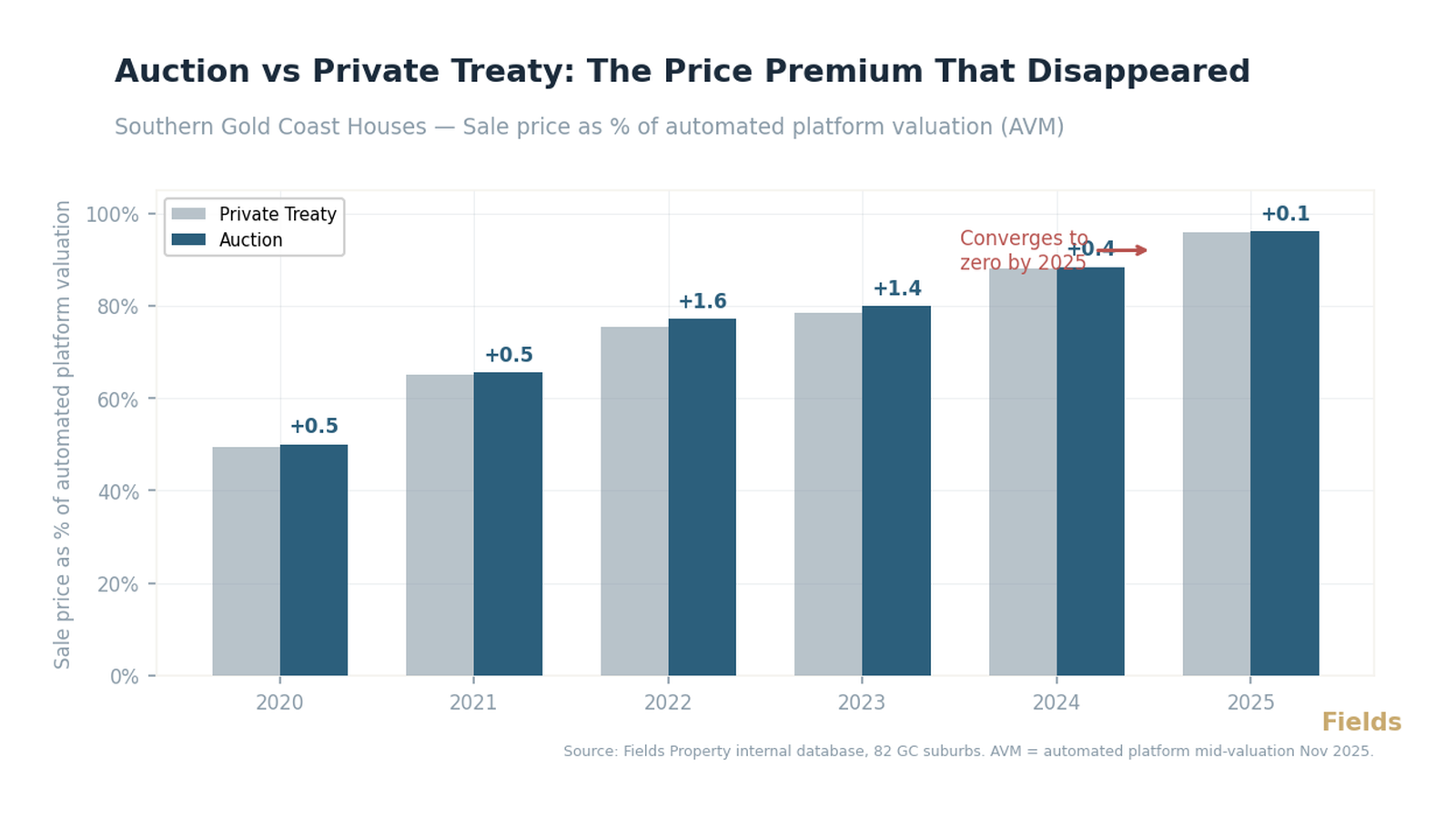
In 2025, Southern Gold Coast houses sold via auction and private treaty achieved statistically identical sale prices relative to their property value. The difference was 0.09 percentage points — less than $900 on a $1 million property.
To make this comparison meaningful, we used Domain's automated valuation model (AVM) as a common reference point — the computer-generated property estimate that appears on Domain listings. By measuring each sale as a percentage of a property's AVM, we can compare auction and private treaty outcomes on a like-for-like basis, controlling for the fact that auction properties tend to be larger or better-located than private treaty equivalents. When you see "% of value" in the tables below, that's the sale price as a proportion of Domain's AVM.
Year
Private Treaty
Auction
Auction Advantage
2020
49.7% of value
49.2% of value
None (PT wins by 0.5 ppts)
2021
64.6% of value
65.2% of value
+0.55 ppts
2022
75.3% of value
76.9% of value
+1.62 ppts
2023
78.3% of value
79.7% of value
+1.44 ppts
2024
87.8% of value
88.1% of value
+0.37 ppts (fading)
2025
95.3% of value
95.4% of value
+0.09 ppts — zero
The auction price premium was real in 2022 and 2023. It existed because buyers were fearful of missing out, bidder competition was intense, and the psychological pressure of the auction room translated into genuine price outcomes. That environment has changed. By 2025, both methods deliver sellers essentially the same result on price.
If the only reason you're considering auction is the assumption that it extracts more money, the current data does not support that assumption for houses.
But Then Why Are More Homes Going to Auction?
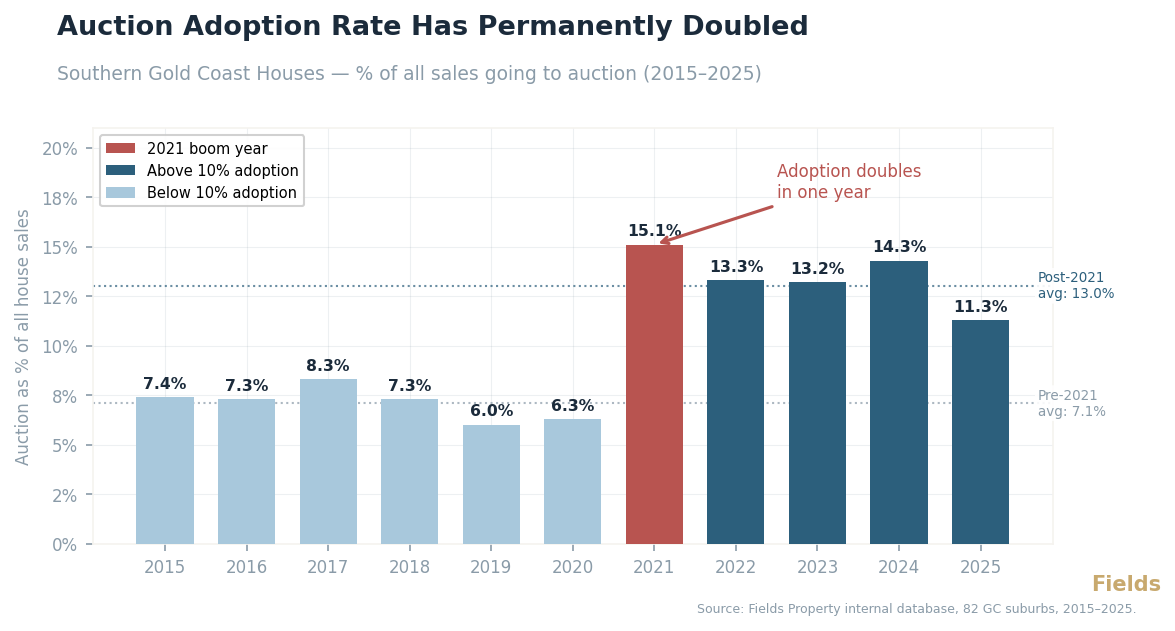
Here's what makes this finding confusing: despite the price premium disappearing, auction adoption has doubled and stayed elevated.
Before 2021, roughly 6–7% of Southern GC house sales went to auction. In 2021 — at the peak of the market — that jumped to 15.1%. It has settled at 11–14% ever since.
Southern GC — House Auction Adoption Rate:
Period
Auction % of Sales
2015–2020
6–8% (stable baseline)
2021
15.1% (boom peak)
2022–2024
11–14% (new normal)
2025
11.3%
Auction adoption roughly doubled in 2021 and has stayed at that elevated level even as the price advantage converged to zero. So agents and sellers are clearly getting something from auction that isn't price.
They are. And it matters. Auction delivers:
Unconditional contracts — no finance clauses, no building and pest clauses that can be used to renegotiate after contract exchange. When the hammer falls, the buyer is legally committed without an escape route.
A defined timeline — you know when your property will sell. There's no open-ended negotiation, no weeks of waiting, no back-and-forth over conditions.
Marketing intensity — a four-week auction campaign with a hard deadline creates urgency that brings buyers forward. Properties that have been sitting on the market for months often respond well to a reset via auction.
No gazumping — unlike private treaty, where a verbal agreement can be undermined by a better offer before contracts exchange, an auction sale is binding the moment the hammer falls.
These are real operational benefits. Agents recommend auction for these reasons even when the price outcome is equivalent — and those recommendations are often rational.
The question to ask your agent is not "does auction get more money?" — because the current data says no, not right now. The question is: "Given my specific property, my timeline needs, and my buyer profile, which method is lower risk and better suited to my circumstances?"
The Part of the Conversation Agents Rarely Have: Clearance Rates
The price outcome question is the one everyone focuses on. But there's a more fundamental question that determines whether any of the above matters: will the auction campaign actually result in a sale?
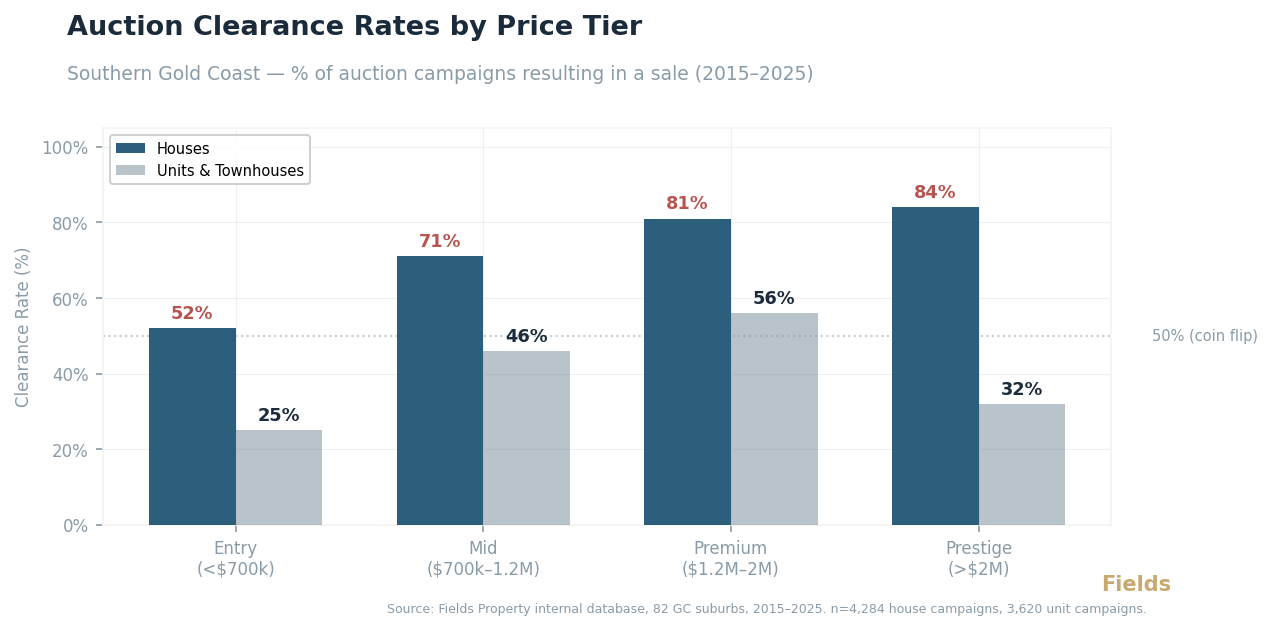
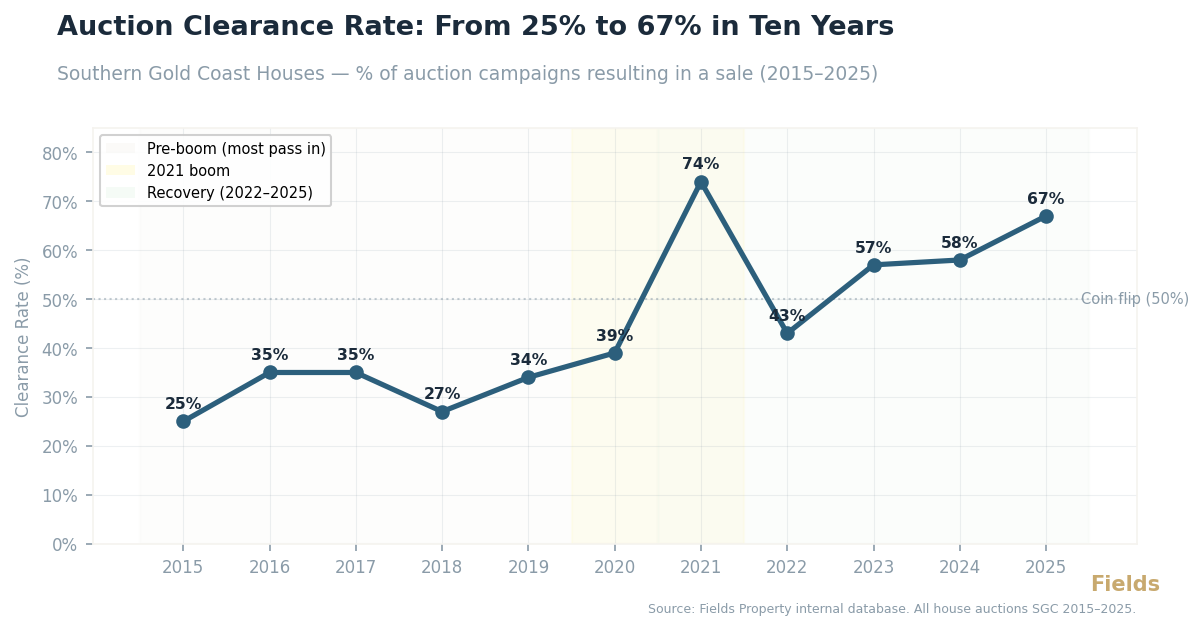
Here is the clearance rate data for Southern Gold Coast house auctions — the percentage of campaigns that produce a sale on or before auction day — broken down by price tier across the full ten-year dataset:
Price Tier
Total Campaigns
Sold
Clearance Rate
Under $700,000
576
299
51.9%
$700,000–$1,200,000
1,264
897
71.0%
$1,200,000–$2,000,000
1,087
884
81.3%
Over $2,000,000
513
429
83.6%
The finding that surprises most people: prestige homes have the highest clearance rate. The common assumption is that expensive properties fail at auction more often because the buyer pool is smaller. The data shows the opposite. Buyers at $2,000,000+ have done extensive due diligence, have clean finance, and when they register to bid, they bid with intent. The result is a pass-in rate of just 16%.
Entry-level houses are the outlier on the downside — a coin flip at 51.9%.
The current trajectory (2024–2025) makes this even more relevant:
Tier
2024 Clearance
2025 Clearance
Mid ($700,000–$1,200,000)
93.5%
73.3%
Premium ($1,200,000–$2,000,000)
90.6%
95.7%
Prestige (over $2,000,000)
91.5%
89.8%
In 2025, if you're selling a $1,200,000+ house via auction, the probability of selling at auction is approximately 90–95%. The risk of a failed campaign is low. Auction is a structurally sound choice from a risk perspective for this segment.
The entry-level situation is different — and agents should be having a more honest conversation with entry-level vendors about it. Below $700,000, nearly half of all house auction campaigns across the ten-year dataset failed to produce a sale. In 2022, only 29% of entry-level house auctions cleared. For recent years there's insufficient volume to compute a reliable figure, which itself tells a story: entry-level house auctions have largely disappeared from the Southern GC market. Even agents appear to have quietly stopped recommending auction for this segment.
What About Units and Townhouses?
The picture for non-house properties is sharply different — and largely unfavourable to auction.
Price Tier
Clearance Rate
Summary
Under $700,000
24.8%
3 in 4 campaigns fail
$700,000–$1,200,000
46.0%
Just under half sell
$1,200,000–$2,000,000
55.8%
Slight majority sell
Over $2,000,000
32.3%
Most fail — difficult to bid unconditionally on complex prestige stock
The entry-level unit clearance rate of 24.8% should give any vendor serious pause. If you're selling a sub-$700,000 unit or townhouse, the data shows that three-quarters of vendors who go to auction end up transitioning to private treaty anyway — after having spent 4 weeks and the associated marketing costs on a campaign that didn't work.
This matters because the post-auction private treaty negotiating position is not necessarily stronger. You've publicly demonstrated that the market didn't meet your reserve. Buyers know this. The framing shifts.
The one unit exception where auction outperforms: High-value units and townhouses at the $1,200,000+ level are the segment where our price analysis shows auction consistently outperforming private treaty — by +1.4 to +5.1 percentage points in the Southern GC. If you're selling a prestige apartment or waterfront townhouse above $1,200,000, auction has genuine price advantages and a reasonable (though not high) clearance rate. This is the segment most likely to benefit from the price discovery that an open, transparent auction process creates.
The Sold-Prior Question: Is It Smart to Accept a Pre-Auction Offer?
Many vendors receive an offer before auction day and face a difficult decision: take the certainty of the offer in hand, or run the risk of the auction to see if the room does better.
The conventional wisdom from agents is often: "hold out for auction day — that's where the real competition happens." The data tells a more complicated story.
Southern GC Houses — Pre-Auction (Sold Prior) vs At Auction:
Year
Sold Prior
At Auction
Who Got More?
2021
68.9% of value
65.0% of value
Sold Prior: +3.96 ppts
2022
77.3% of value
76.9% of value
Sold Prior: marginal +0.4 ppts
2023
79.7% of value
79.7% of value
Identical
2024
88.0% of value
88.2% of value
At Auction: fractional edge
2025
95.1% of value
95.5% of value
At Auction: fractional edge
In 2021, vendors who accepted pre-auction offers left nearly 4 percentage points on the table compared to those who ran the full auction. That was the height of buyer FOMO — buyers who offered pre-auction were paying a premium precisely to avoid the auction room. Agents were right to counsel patience.
That environment no longer exists. In 2024 and 2025, vendors who accepted pre-auction offers received fractionally less than those who went to auction day. The difference is tiny — but the direction has reversed.
What does this mean in practice? A strong pre-auction offer in today's market deserves genuine consideration. If the buyer is offering a number that meets your expectations, is unconditional, and settles on your preferred terms — the data does not support the argument that you will systematically do better by refusing and waiting for auction day. Evaluate the offer on its merits, not on the principle that "auction is always better."
A Decision Framework by Property Type
The data supports the following general positions:
Prestige houses (over $2,000,000): Auction is well-suited. Clearance rates are strong (84%+ overall, 90%+ currently). Price outcomes are marginal but positive for auction. The unconditional contract benefit is particularly valuable at this price point. ✓ Auction is a rational choice.
Premium houses ($1,200,000–$2,000,000): Strong clearance rates (81%, and above 90% currently). Price outcome is marginally in private treaty's favour (−1.2 ppts) but within noise. Auction reduces the risk of a failed campaign to below 10% while delivering equivalent price outcomes. Either method works; the decision should be driven by your timeline and buyer profile. ✓ Auction is a rational choice. ✓ Private treaty is equally valid.
Mid-range houses ($700,000–$1,200,000): Clearance rates are good (71% overall, 73–94% recently). Price outcome is marginally in private treaty's favour (−1.9 ppts). Auction's operational benefits — unconditional contracts, defined timeline — may justify the choice even though the price advantage is absent. The decision should be based on your specific buyer profile and whether you need certainty of sale by a date. Either method is defensible. → Discuss with your agent based on your situation.
Entry-level houses (under $700,000): Clearance rates are the lowest of any house segment (51.9% overall). Price outcomes favour private treaty (−1.3 ppts). Auction offers no reliable advantage for this segment in the Southern GC. Entry-level house auctions have largely vanished from the market for this reason. ✗ Private treaty is the more logical choice.
Premium and prestige units/townhouses (over $1,200,000): The one clear case where auction's price advantage is consistent and meaningful (+1.4–5.1 ppts). High-value units are genuinely difficult to price via private treaty comparables, and auction creates transparent price discovery. Clearance rates are moderate (56% for $1,200,000–$2,000,000; lower for prestige). In this segment the measured price advantage is larger than in any other, and it sits against the campaign risk carried by an auction that does not clear.
Entry and mid-level units/townhouses (under $1,200,000): Clearance rates are poor — 24.8% for entry-level and 46% for mid. Three-quarters of entry-level unit auction campaigns do not produce a sale. The post-auction private treaty position is typically weaker than launching as a private treaty listing from day one. ✗ Private treaty is strongly preferred.
The Questions to Ask Your Agent
When your agent recommends auction, these are the questions worth asking:
1. "What is the current clearance rate for properties like mine in this suburb?" If they can't answer this specifically — by price tier and property type, not just a general market figure — that's a red flag. The clearance rate is the single most important risk variable for your decision.
2. "What happens if it passes in?" Walk through the post-auction scenario explicitly. Understand what your negotiating position looks like, how the property will be relaunched, and what the typical trajectory is for passed-in properties in your segment.
3. "Are you recommending auction because of the price outcome, or because of the operational benefits?" Both can be valid reasons. But they're different conversations. If the answer is price — ask to see the data.
4. "In the current market, has auction been outperforming private treaty for properties like mine?" 'Current market' means the last 12 months, not the 2021 boom cycle that many agents still reference as their mental model for auction performance.
5. "If I receive a strong pre-auction offer, what would you recommend?" Their answer will tell you whether their advice is informed by current data or by a general principle that hasn't been revisited since the market shifted.
The Bottom Line
The auction advantage for Gold Coast house sellers was real in 2022–2023. It has converged to statistically zero by 2025.
That doesn't mean auction is the wrong choice for your property — the operational benefits are genuine, and for Premium and Prestige houses the clearance rates are currently excellent. What it does mean is that the decision should be made on facts relevant to your specific property and current market conditions, not on inherited wisdom from a market cycle that has passed.
The data supports one clear conclusion: property type and price tier determine whether auction is appropriate, not a general principle that auction is always better.
Your agent should be able to show you that evidence, specific to your property, before you sign the authority.
Keep reading:Gold Coast market data — prices, supply and selling times, updated as new sales settle.
Data sourced from Fields Property internal database (Fields data), covering 82 Gold Coast suburbs, 2015–2025. AVM ratios calculated against Domain mid-valuations, November 2025. Total transactions analysed: 232,465 (sold) + auction clearance data from 43,000+ auction campaign records.
Licensed Queensland real estate agent, founder of Fields Real Estate and Lead Analyst at Fields Research. Covering Gold Coast market data, comparable sales analysis and suburb intelligence.
Where does your own home sit?
Fields keeps a record of every active listing and recent sale across the southern Gold Coast, and reads any address against the sales around it — the comparables, the range they support, and the method behind it. This analysis of the Gold Coast comes from the same database.