What do comparable sales say about your home?Your home vs recent sales
Enter your address to see the comparable sales around it. Free, no sign-up.Free comparable sales for your address.
🔍
Analyst21 August 2026·Updated 15 September 2026·6 min read
Thinking of selling? The number that matters isn't the one in the headline
For anyone selling to buy again, the price of your home is rarely the number that decides anything. The gap between your home and the next one is — and it moves very differently.
If you own a home and have thought about selling it, the number you have watched is almost certainly its price — what it might fetch, and whether that figure is rising or falling. It is the number in every headline and every appraisal.
For most owners, though, it is not the number that decides anything. Very few people sell to hold cash; they sell to move — up, down, or sideways into a different home. And the moment there is a next home, the figure that actually governs the decision is not your home’s price. It is the gap between what you would sell for and what you would pay next.
Why the gap matters more than the price
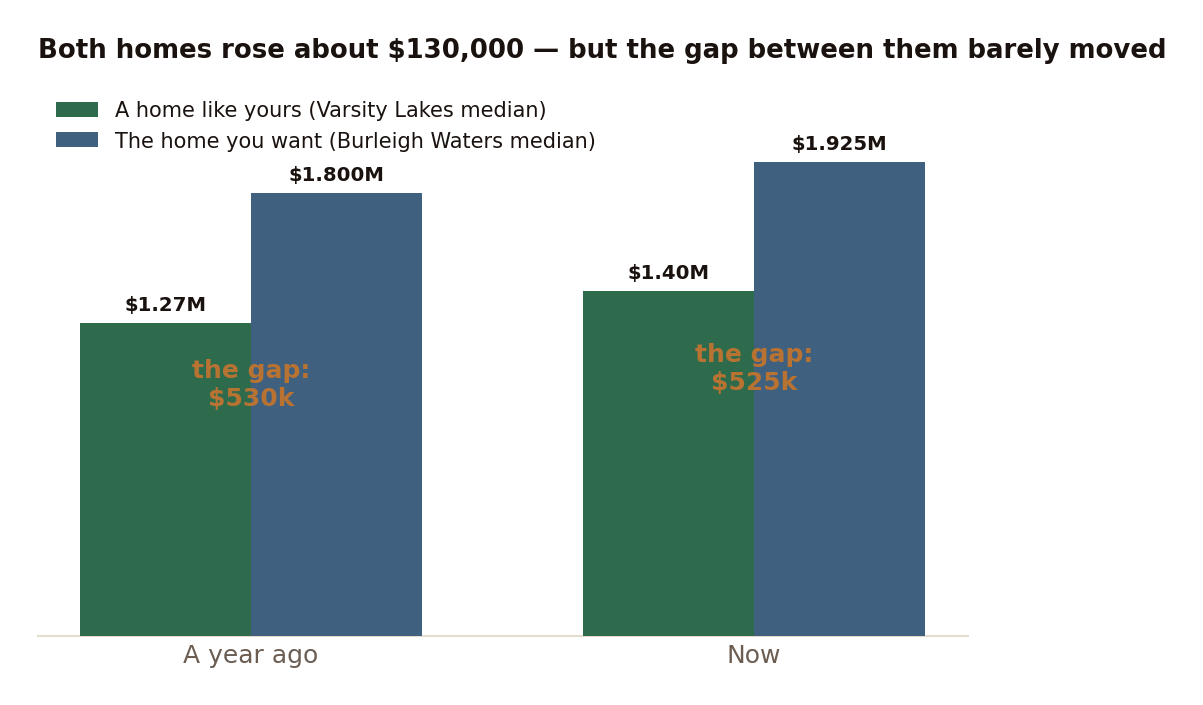
Consider a homeowner who owns a home worth around the Varsity Lakes median and would like to move to something around the Burleigh Waters median. A year ago, those two figures were about $1.27 million and $1.80 million — a gap of roughly $530,000. Today they are about $1.40 million and $1.925 million — a gap of about $525,000.
Both homes rose by roughly $130,000 over the year. The gap between them — the amount this owner would actually need to find to make the move — barely changed at all.
A home like yours and the home you want, a year ago and now (suburb medians). Both rose about $200,000 — but the gap you would need to fund the move barely changed.
This is the part the headline hides. When the whole market rises, your home is worth more — and so is the one you want, by a similar dollar amount, so the distance between them moves far less than either price. When the whole market falls, the same thing happens in reverse: your home is worth less, but so is the next one, and the gap narrows. For someone staying in the market, a rising market and a falling market are both, to a large degree, a wash. The price on the front page is mostly noise to the person who is going to spend the proceeds on another home in the same market.
The gap is moving differently across the Gold Coast
The gap is only stable when the two homes move together — and over the past year, our three tracked suburbs did not. Varsity Lakes rose 10.2%, Burleigh Waters 6.9% and Robina 5.8%. Because they moved at different rates, the gaps between them shifted — and not all in the same direction.
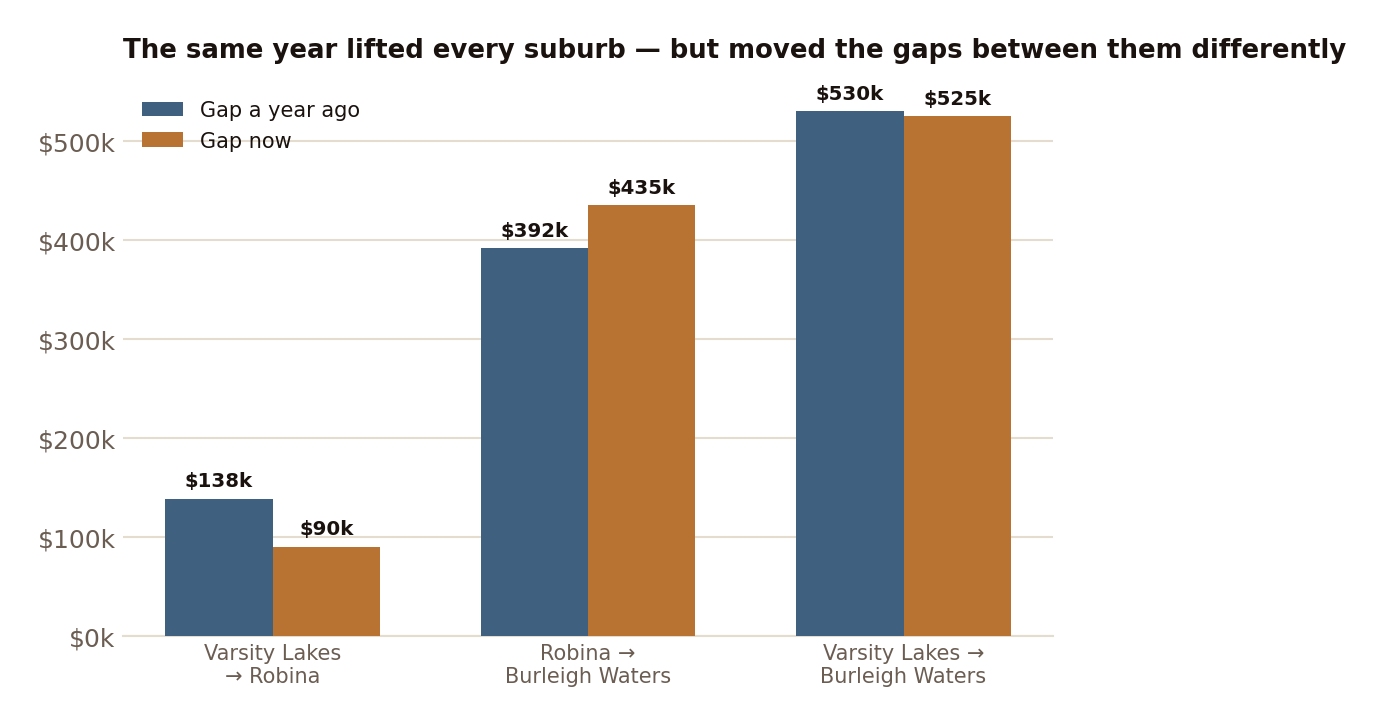
The gap between a Varsity Lakes home and a Robina one narrowed, from about $138,500 to $90,000. Varsity Lakes grew faster, closing most of the distance to Robina.
The gap between a Robina home and a Burleigh Waters one widened, from about $391,500 to $435,000.
The gap between Varsity Lakes and Burleigh Waters — the move in the example above — barely moved, from about $530,000 to $525,000.
The gap between suburb medians, a year ago and now. Every suburb rose, but the gaps between them moved in different directions — one narrowed, one widened, one held.
So “the gap” is not one number. Over the past year, moving from Varsity Lakes up to Burleigh Waters cost about what it did before; moving from Robina up to Burleigh Waters cost roughly $43,000 more; and moving from Varsity Lakes across to Robina cost almost $50,000 less. The direction of the move decided whether the year helped or hurt — and none of that is visible in the headline that each suburb simply “went up”. The useful question is not “is the market up or down?” but “what has happened to the distance between where I am and where I want to be?”
The other half of the gap: what it costs to fund
For a move that involves borrowing, the gap is only half the picture; the cost of bridging it is the other half.
That cost has risen. The Reserve Bank has lifted the cash rate three times in 2026, to 4.35%, and held it there since June, with no major bank now expecting a cut before 2027. Borrowing capacity has fallen by roughly seven per cent since the start of the year, and wages have grown more slowly than prices, so real incomes have gone slightly backwards. A given gap, in other words, is more expensive to finance than it was twelve months ago — and that weighs most on moves that require the largest new loan, and least on those funded mostly by equity.
This is why two owners looking at the same market can reach opposite conclusions and both be reasoning correctly. An owner trading down, releasing equity, faces a shrinking or negative gap and cheaper-to-fund position. An owner trading up, borrowing to cover a widening gap, faces the opposite. The market is one thing; what it means for a given household depends on which direction they are moving and how much of the gap they need to borrow.
What the data can, and cannot, tell you
Our data can tell you where prices sit, how confident we are in each figure, how long homes are taking to sell in each suburb, and how the gap between suburbs has moved. It cannot tell you what happens next — we do not publish price forecasts, and this year, in which the country’s most hawkish major bank reversed its interest-rate call within three weeks, is a good illustration of why.
Nor can it answer the questions that actually decide a move, because those are not market questions. Whether to sell before buying or buy before selling; whether this spring suits your circumstances better than next; how much of the gap you are comfortable borrowing — these depend on your own position, not on the median. What the data can do is take the headline price out of the centre of the decision, where it does not belong, and put the gap there instead.
The questions worth holding
If you are weighing a move, three questions carry more information than the price of your home:
What is the gap between a realistic sale price for your home and the likely cost of the one you want — and which direction is that gap moving?
How much of that gap would you fund by borrowing, and how has the cost of that borrowing changed?
Are the two suburbs moving together or apart — because that, not the citywide figure, is what changes the gap.
The price of your home is the number everyone watches. For anyone planning to spend it on another home, it is rarely the number that matters most.
Sources: Fields Estate transaction data for Robina, Varsity Lakes and Burleigh Waters, compiled from public sale records, twelve months to 2 August 2026. Rates and borrowing context: Reserve Bank of Australia media release 2026-19, 11 August 2026; ABS Wage Price Index and Consumer Price Index. This article is general information about how property markets work, not financial or property advice.
Keep reading:Gold Coast market data — prices, supply and selling times, updated as new sales settle.
Licensed Queensland real estate agent, founder of Fields Real Estate and Lead Analyst at Fields Research. Covering Gold Coast market data, comparable sales analysis and suburb intelligence.
Where does your own home sit?
Fields keeps a record of every active listing and recent sale across the southern Gold Coast, and reads any address against the sales around it — the comparables, the range they support, and the method behind it. This analysis of the Gold Coast comes from the same database.